A Practical Guide to Naming Your Precast Company
Read Time: 8 min, 36 sec

The Ground Work
Short on time? Here are this article’s key takeaways…
Your product and company name directly impact sales, clarity, and long-term growth. The right name helps customers understand and buy; the wrong one creates confusion.
Naming decisions should be made with the future in mind, leaving room to add products, expand into new territories, and evolve your business over the coming decades.
Avoid common pitfalls, such as using Aster Brands product names or narrow geographic terms in your company name, both of which can limit growth.
There’s no one-size-fits-all approach, but proven principles, scenarios, and dos and don’ts can guide you toward a clear, flexible, and credible naming strategy. We’ll even give you some helpful resources to take your naming to the next step.
Introduction
In concrete manufacturing, a product name does more than sound good — it determines whether the market understands the product and buys it. The right name makes it easy for your sales team to sell and for customers to remember. The wrong name can lead to confusion and a product that never quite earns its place in your portfolio.
When you start manufacturing an Aster Brands product, it’s critical to think about how you’ll integrate the product line into your existing brand. Are you starting a new business unit, or simply integrating the Aster Brands product into your existing company? How do your business needs impact your naming strategy? The decisions you make now lay the groundwork for decades of future growth.
Naming and brand strategy are unique to every business and market, but there are key best practices that can make your process easier. This article breaks down the best practices we’ve identified while working with 200+ concrete manufacturers since 2000. Inside, you’ll find dos and don’ts, three core principles, naming scenarios with examples, and a simple process to help you determine how to integrate your new product line into your business.
3 Principles of Naming Your Business
#1: Begin with the End in Mind
If you’re manufacturing an Aster Brands product, you’re likely planning for long-term growth and ongoing innovation, not a one-time expansion. Your brand name should support that trajectory, not constrain it. Starting with the end in mind helps ensure your naming strategy leaves room for future products, markets, and opportunities.
There are two naming conventions we’ve seen in the Aster Brands network that have consistently limited manufacturers over time:
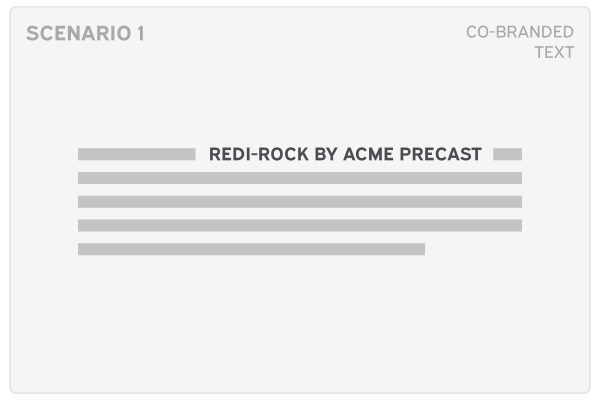
Choosing an official company name that includes an Aster Brands brand name. Including an Aster Brands product name in your company name may seem beneficial for brand recognition, but it often creates confusion when additional product lines are added. Take Michigan’s first Rosetta Hardscapes manufacturer, “Rosetta of Michigan,” for example. Now known as High Format, Rosetta of Michigan enjoyed great success producing Rosetta, which led to the addition of the Redi-Rock and Pole Base lines. Customer confusion ensued as the “Rosetta of Michigan” name no longer accurately described the company’s product suite. As manufacturers expand their offerings or discontinue a product, a brand-specific name can force costly renaming, rebranding, and market uncertainty. For this reason, we no longer allow Aster Brands product names to be used in manufacturer business names. We do, however, allow and encourage co-branding with product names (sometimes called “brand endorsement lines”) within your marketing materials. This is when one brand is being endorsed, licensed, or delivered by another brand. For example, marketing Redi-Rock with “Redi-Rock by Acme Precast” brand endorsement line is a great way to capitalize on Redi-Rock's national market recognition while promoting your company’s capacity to deliver an industry-leading solution.
Choosing a name that includes a limited geographic area. Geographically narrow company names can restrict growth. In the “Rosetta of Michigan” example listed above, we cite brand confusion due to a narrowed product focus as the issue. But including a specific geographic area in the name also limited its long-term relevance. As territories expand or new plants open, names tied to a specific location can mislead customers and unintentionally signal limited service areas. In hindsight, broader regional naming allows far more flexibility. Consider Redi-Rock, Rosetta Hardscapes, and Pole Base producer Deep South Precast in Canton, Mississippi. With its name, Deep South Precast has effectively localized its business without limiting itself to a single state, county, or city. By choosing a name that balances geographic relevance with broader appeal, a company can preserve local credibility while avoiding artificial constraints on future growth.
Avoiding these two naming pitfalls and planning with long-term growth in mind sets your brand up for a stronger future.
#2: Be Clear and Descriptive
Your name should clearly communicate what you do without limiting where your business can go. The goal is a balance: specific enough to build trust and understanding, broad enough to support future growth.
In construction and hardscape markets, clarity signals credibility. Customers, spec writers, and planners should immediately understand the role you can play in their success. That’s why many Aster Brands manufacturers use familiar industry terms like precast, concrete, or hardscapes, language that fits naturally into specifications and planning documents. If those terms don’t belong in your name, they can still be used effectively in a tagline or visual branding.
#3: When Your Current Name Isn’t Serving You, Rethink It
Businesses grow and evolve over time. You may have pivoted into a different industry, or you’re now serving a totally different customer base. Even if you begin with the end in mind, sometimes your business changes in ways you couldn’t have predicted. And sometimes, because of that, your name no longer fits.
As painful as that can be - don’t be afraid to rethink your name!
Creating a new business unit or DBA can be difficult and time-consuming, but it can bring the clarity your market needs as you launch a new product and set you up for long-term growth. When your original name is no longer serving you, it may be time to rethink it.
4 Common Naming Scenarios
We’ve compiled four of the most common naming circumstances we’ve encountered with our producer-partners. Chances are, one of the scenarios below closely aligns with your current naming challenge.
Scenario 1: You’re a Well-Established Concrete Product Manufacturer Adding an Aster Brands Product as a New Product Line
When a manufacturer takes on an Aster Brands product line, they’re usually a well-established company in the precast industry. Whether they’re making burial vaults, commodity precast products, hardscapes, or something else, they’ve already gained a foothold as a trusted solution for precast concrete products in their area. It makes sense to lean into their existing brand equity to promote this newest addition to their product line.
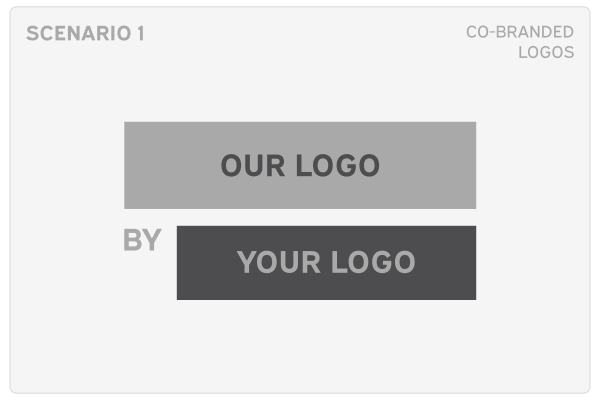
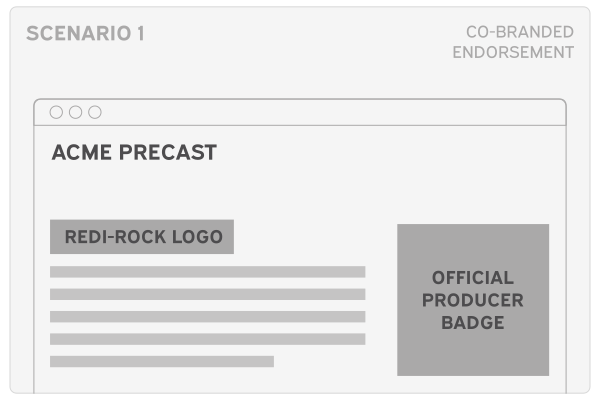
In this scenario, we recommend using a co-branding approach. This means you can use an Aster Brands product name when launching a new product line.
Example:
- Company Name: Acme Precast
- Co-Branded Product Line: Redi-Rock by Acme Precast
This leverages your brand equity while tying into the well-established Aster Brand. You are still legally known as your registered business name, but you can use the co-branding technique to integrate the new offering into your marketing, such as a new page on your website. For more co-branding specifics, guidelines are available on the Producer Secure sites for Redi-Rock, Rosetta Hardcapes, Novum Wall, and Pole Base.
Takeaway:
You’ve already built a reputation and have a lot of brand equity with your existing company name. Promote your new Aster Brands product line as a core product for your brand through co-branding.
Scenario 2: You’re a Well-Established Business and Brand, But in a Different Industry
A common approach is to leverage your existing brand name to gain attention in the new industry.
This approach also applies to manufacturers transitioning from niche markets. Many producers of Aster Brands products also manufacture burial vaults, but those audiences and sales cycles differ significantly. In these cases, retaining the core brand while replacing terms like “vault” with “precast” or “concrete products” helps clarify the shift without discarding years of brand equity.
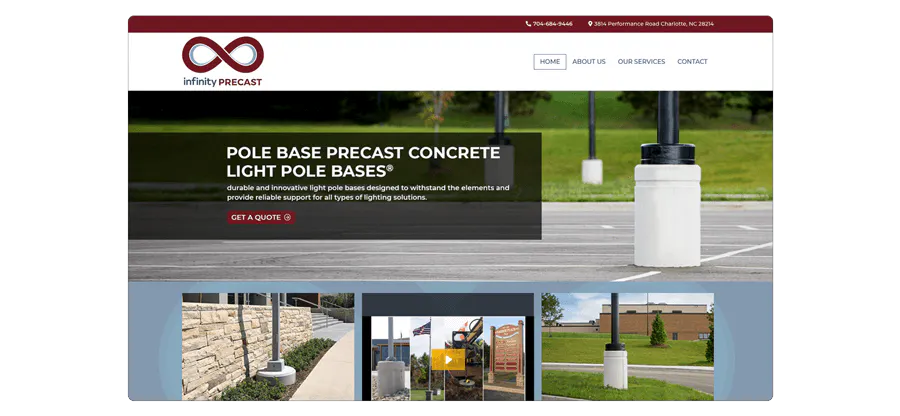
For example, Infinity Contractors in Charlotte, North Carolina, expanded into precast manufacturing when it added the Pole Base product line, launching Infinity Precast. Their existing name maintained recognition while clearly signaling a new product category.
If your existing name doesn’t lend itself to this approach, that’s okay. There are often simple naming adjustments or alternative strategies that can support both clarity and growth. We’d love to talk to you about this more!
Takeaway:
Sometimes your existing company name is too far removed from precast or hardscapes to make sense within the concrete manufacturing industry. Consider using your base name but modifying it to include your new business venture.
Scenario 3: You’re an Entrepreneur Starting a New Business to Manufacture Precast Products
Sometimes entrepreneurs see an opportunity with Aster Brands to build an entirely new business from the ground up. In these cases, the potential is virtually unlimited. Our strongest advice: choose a name that leaves room to grow. Avoid tying your identity to a single Aster Brands product or a narrow geographic area. Both can limit future expansion.
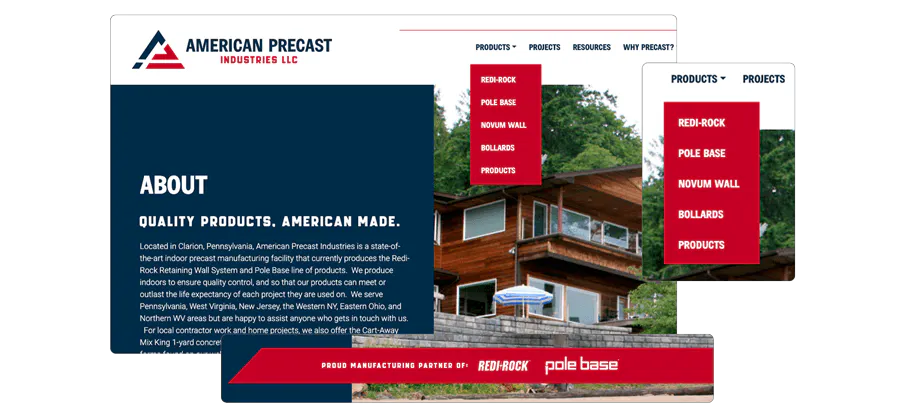
American Precast Industries is a great example. Founded by a pair of young, driven entrepreneurs with no prior precast experience, the company identified a market gap and entered the industry in 2020, producing Redi-Rock and Pole Base. Since then, they’ve expanded into Novum Wall and, most recently, Velpont. By leaning into their “Made in America” identity, they’ve built a highly successful and growing operation in central Pennsylvania.
Takeaway:
Even if you’re creating an entirely new business unit, don’t make your company name brand-specific or location-specific. Create a name that will allow your company to grow and change over the years - rather than a name that ties you to one brand and one location!
Scenario 4: You Own a Suite of Business Units and Want to Create an Umbrella Brand to Unify Them
If your company has been growing through acquisitions or by launching new businesses, you may have reached a point where you need to unify your branding and introduce your new Aster Brands product line under that umbrella name. We’ve seen this scenario across the network multiple times over the years.
This is a complicated scenario, and there is no “one size fits all” approach. What we can share with you is our process for creating Aster Brands and the lessons we learned along the way. Contact your marketing consultant, Lindsey Manthei O'Connor, at lindsey@asterbrands.com or 231.330.3110.
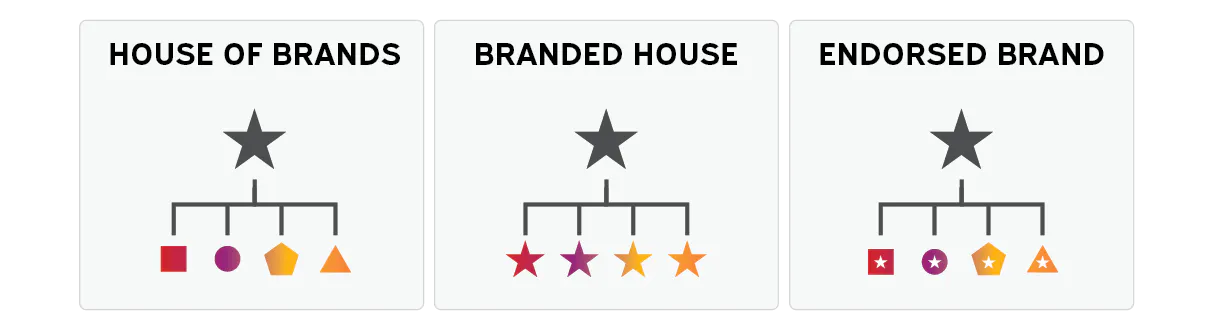
It can also be helpful to read about brand architecture and examine the concepts of endorsed brands, source brands, house of brands, and master brands.
Takeaway:
You’ve already built a reputation and have a lot of brand equity with your existing company name. Promote your new Aster Brands product line as a core product for your brand through co-branding.
Do’s and Don’ts
Ultimately, your brand architecture and naming choices are entirely in your control. Choosing the right precast producer name is a strategic decision that can support long-term growth, so keep the following dos and don’ts in mind as you make your decision.
Do Choose a Business Name That:
- Capitalizes on your existing brand equity whenever possible
- Inspires trust
- An engineer, architect, or municipality would be proud to put on specs and plans.
- Is clear and descriptive
- Follows the SMILE principles
Don’t Choose a Business Name That:
- Includes an Aster Brands brand name. This limits what product lines you can easily add in the future without confusing your customers, and can result in time-consuming and expensive name alterations later on (we’re talking a lot of government paperwork–nobody wants that)
- Includes a limited geographic element. Specific geographic elements in your name can limit your ability to expand your territory over time.
- Creates confusion about what you actually do.
- Includes the SCRATCH principles
Next Steps
You’ve read the guidelines, you understand the pitfalls. Now it’s time to chart your course for future growth. Here are some suggestions for your next steps.
Brainstorm. If you’re starting a new business unit or undergoing a rebrand, brainstorming is particularly crucial. We really like the naming process outlined in Alexandra Watkin’s book Hello My Name is Awesome.
Run your ideas through the SMILE and SCRATCH Test. Also from Hello My Name is Awesome, the SMILE and SCRATCH framework helps you identify names that will perform well and names that will struggle. Explore the online evaluator for SMILE and SCRATCH to learn more.
Discuss your brand architecture names/ideas with the Aster Brands team. It’s not required, but we’re always happy to brainstorm and discuss naming challenges and ideas with you.
Test your name ideas with your team and a few key customers. Choosing a name that your sales team supports is critical. But it’s also essential to choose a name that your customers understand. Beware of killing good names with focus group testing, though.
Prepare a solid launch plan. As with any product/brand introduction, there are a thousand ways to bring a product to market. Our strongest recommendation is to start communicating about your new product launch as soon as possible to help spread awareness in your market. Build anticipation with a social media strategy, begin educating specifiers and contractors, and start building your online presence well before you plan to go public.
Naming and building brand architecture can feel overwhelming. That’s why we’re here to help. We won’t have all the answers, but we have loads of experience assisting manufacturers through this process over the past few decades. We’re here to support you every step of the way, so please contact us with any questions.

Contributing Expert
Lindsey Manthei O'Connor
Since 2008, Lindsey has been working with concrete manufacturers to help optimize their marketing strategies and content. Outside of work, Lindsey spends most of her time digging in her garden, playing with her daughter, renovating rental houses, or diving into a good book.