A Sustainable Modular Bridge Solution
Velpont is a fast, cost-effective, reliable, and environmentally friendly modular bridging solution for road-stream crossings. Explore a smart, sustainable alternative to steel pipes, culverts, and cast-in-place bridges.
A Responsible Solution for Road-Stream Crossings
Velpont bridges are built to balance performance, practicality, and environmental responsibility, everything a modern crossing should achieve.

Speed
Velpont bridges install far faster than traditional culverts or cast-in-place alternatives thanks to pre-engineered modular components that fit together with ease. Smaller crews using standard excavators—not cranes—can complete installations in days, reducing road disruption and restoring access sooner.

Sensibility
Every aspect of Velpont is designed for efficiency and value. Its modular system simplifies engineering, streamlines logistics and permitting, and keeps construction out of the streambed, delivering a cost-effective solution for immediate impact and long-term performance.

Safety
Velpont’s open-bottom design preserves natural stream flow, reducing flood risk and preventing catastrophic road washouts common with culverts. Its reinforced wet cast concrete and interlocking blocks deliver lasting strength you can trust to safeguard travelers, both above and below.

Sustainability
Velpont supports both environmental and infrastructure resilience by avoiding in-stream excavation to preserve habitats and restore natural aquatic passage. With a lifespan exceeding 75 years, it’s a sustainable investment that protects waterways and minimizes future rebuilds.
An Installer’s Perspective
Hear from Brendan Scully of Scully Construction about what it’s like to work with Velpont.
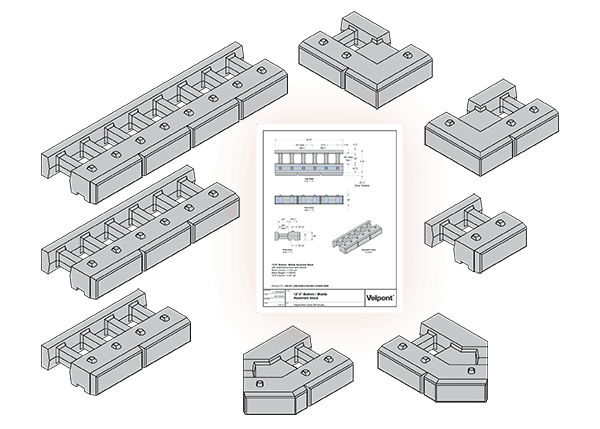
The Building Blocks of the Operation
Additional components continue to be developed, but you can explore the currently available blocks that make bridge building faster, stronger, and more sustainable.

"When you are able to fix a road stream crossing such that it behaves and acts as though the road wasn't there at all, it really allows full ecosystem functionality. And that's the beauty of open bottom bridge structures.”
—Steve Tatko, Appalachian Mountain Club
A Face Everyone Can Love
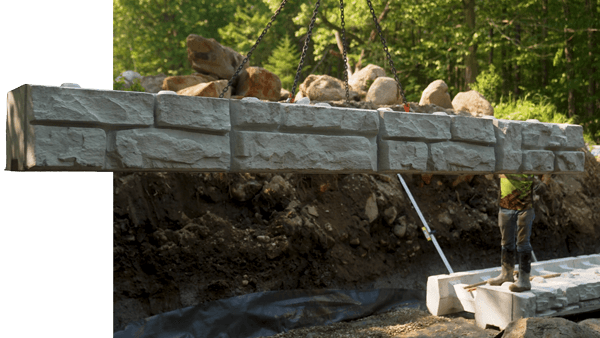
Velpont’s deeply textured face mimics the rugged beauty of real stone, blending seamlessly into the local landscape. Its architectural-grade finish delivers lasting durability with an appearance that complements waterways, landscapes, and the communities they serve.
Instant Impact Crossings
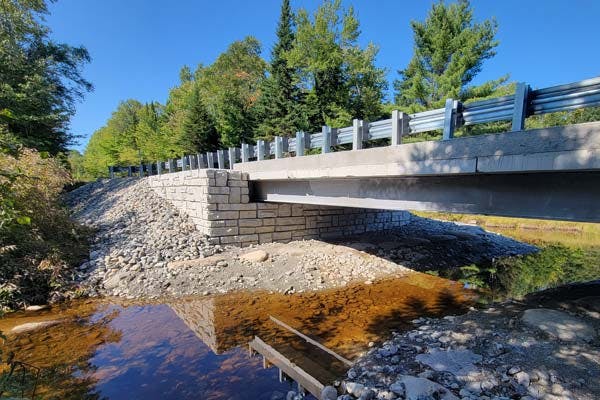
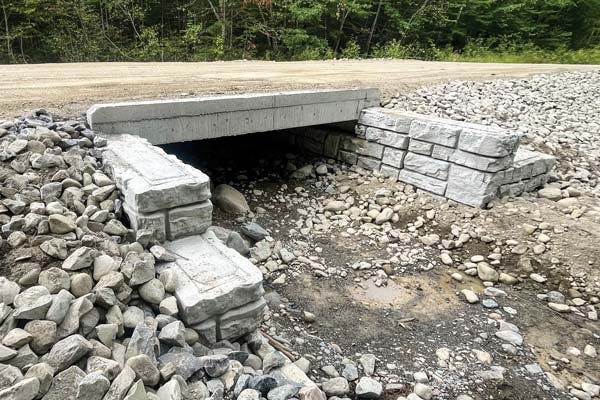
Bog Brook (Brownville, Maine)
Length: 40 ft (12.2 m) Span (33 ft [10 m] Clear Span)
Width: 24 ft (7.3 m)
Partners: U.S. Fish & Wildlife Service, Maine Inland Fisheries & Wildlife
The Bog Brook project replaced a deteriorating culvert to restore natural water flow and strengthen the site’s overall infrastructure resilience.
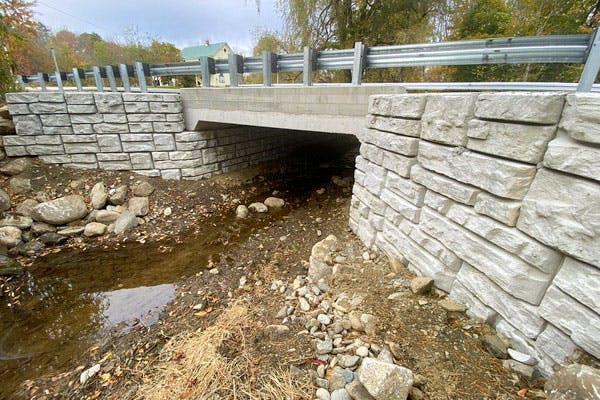
Sucker Brook (Brownville, Maine)
Length: 15 ft (4.5 m) Box Beam (12 ft [3.6 m] Clear Span)
Width: 40 ft (12.2 m)
Partners: U.S. Fish & Wildlife Service, Maine Inland Fisheries & Wildlife
The Sucker Brook project eliminated failing culverts that had created dangerous flooding during storm events, including water flowing over the roadway.
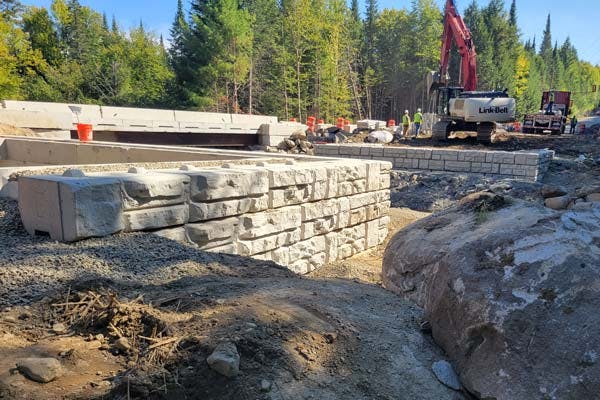
Garland Road (Charleston, Maine)
Length: 17.5 ft (5.3 m) Span (14.5 ft [4.4 m] Clear Span)
Width: 36 ft (10.9 m)
The Garland Road project removed undersized culverts to strengthen road infrastructure and increase freedom of passage for fish and other aquatic organisms.
Alder Brook (Brownville, Maine)
Length: 55 ft (16.7 m) Box Beam (48 ft [14.6 m] Clear Span)
Width: 28 ft (8.5 m)
Partners: U.S. Fish & Wildlife Service, Maine Inland Fisheries & Wildlife
The Alder Brook project replaced failing culverts that caused yearly washouts, boosting road resilience and restoring aquatic passage for native species.
Frequently Asked Questions
Why was the Velpont bridge solution created?
Velpont was created to address millions of aging, flood-prone, and ecologically damaging road–stream crossings that are costly and slow to replace. Traditional options like steel culverts, box culverts, and cast-in-place bridges often take too long, disrupt stream ecosystems, and struggle to adapt to diverse site conditions and regulatory expectations.
What is the widest stream crossing that can host a Velpont bridge?
Velpont can be used on stream crossings spanning up to 80 ft.
How are Velpont abutment blocks manufactured?
Abutment blocks are produced by pouring architectural-grade wet cast concrete into modular steel forms. Rebar frames or cages are placed within the forms before filling for reinforcement. After curing, the blocks are extracted and ready for installation.
Why is wet cast concrete preferred for cold and/or wet climates?
Wet cast concrete has lower porosity than dry cast, reducing expansion and contraction during freeze–thaw cycles. Unlike steel culverts, it also resists corrosion from water and road salt.
Why are Velpont abutment blocks crafted with voids?
The hollow-core design reduces weight for simpler shipping and handling, and it allows additional concrete and rebar reinforcement during installation.
How long does it take to install a Velpont bridge?
Typical construction takes days instead of weeks, significantly faster than traditional alternatives.
What equipment is needed to install a Velpont bridge?
Minimal heavy equipment is required: a 65,000–85,000 lb machine or small crane, lifting equipment, plate compactor or roller, concrete vibrator, and hand tools. Depending on site needs, post-tensioning jacks, dewatering pumps, hoses, filtration, cofferdams, and other specialized equipment may be necessary.
What's the typical crew size to install Velpont?
Small crews—often 3–5 people—can efficiently install a Velpont system.
Why are Velpont bridges better for crossings prone to flooding?
Unlike culverts and box crossings that constrict channels, Velpont lets the stream follow its natural bed, preventing unnatural acceleration, reducing downstream erosion, and eliminating perching that traps debris and causes washouts.
Does Velpont reduce permitting complexity?
Often, yes. The minimal in-stream work needed for installation can ease permitting requirements.
Where can I find financial assistance for a road–stream crossing?
Potential grant sources include the Natural Resources Conservation Service, National Oceanic and Atmospheric Administration (NOAA), U.S. Fish and Wildlife Service, Trout Unlimited, and state environmental programs.
Smart Infrastructure. Natural Balance.
With every Velpont installation, you restore natural flow, support wildlife passage, and invest in resilient infrastructure that respects the environment.